

No, it is not rude to skip a handwritten thank-you note after receiving flowers if you thank the sender another way. A personal text, phone call or face-to-face thank-you is a considerate alternative; leaving the gift entirely unacknowledged is what to avoid. If you are grieving, unwell or caring for a new baby, put your wellbeing before correspondence.
- A thank you note after receiving flowers is optional; acknowledge the sender in a way that suits your relationship.
- Choose a text for everyday gifts, a card for a lasting keepsake, or a call for personal conversation.
- Bereavement, illness and new parenthood are reasons to remove pressure, not impose a thank-you deadline.
- Harrysflowers offers London flower delivery; receiving a bouquet does not oblige you to send flowers back.
Why this matters
A thank-you does two useful jobs: it tells the sender the flowers reached you and recognises the thought behind them. You do not need formal stationery to do either.
For flower-gift etiquette in 2026, choose a sincere acknowledgement over an elaborate response. If the bouquet includes a card, keep it until you have replied so you can check the sender's name and message. The guide to flowers with a personalised message card covers the sending side of that exchange.
Separate gratitude from obligation. You can appreciate a kind gift without writing a letter, sharing a photograph publicly or buying something in return.
Is it rude not to send a thank-you note after flowers?
Not sending a written note is different from not saying thank you. A direct acknowledgement is the useful part; the format is your choice. Choose a response that fits your relationship, your circumstances and the way you normally communicate.
| Response | Best for | What it does well | Limitation |
|---|---|---|---|
| Personal text | Friends and relatives you message regularly | Confirms receipt and expresses thanks directly | Gives you less room for a longer reflection |
| Handwritten card | Someone who values written correspondence | Creates a personal keepsake | Requires writing materials and a postal address |
| Phone call | Someone you enjoy speaking with | Lets you thank them through conversation | Requires energy and a suitable time to talk |
| Colleagues, clients and organised group gifts | Fits a professional exchange | Needs a personal detail to avoid sounding routine | |
| In-person thanks | A sender you will see shortly | Lets you acknowledge the gift face to face | Leaves receipt unconfirmed until you meet |
If you have already thanked someone warmly on the phone, you do not need to repeat yourself in writing just to satisfy an imagined rule. Add a card because you want to, not because a text somehow cancels out your gratitude.
If you have not replied at all, send a short message now. Do not let choosing the perfect response become the reason you never acknowledge the flowers.
How do you write a thank-you note after receiving flowers?
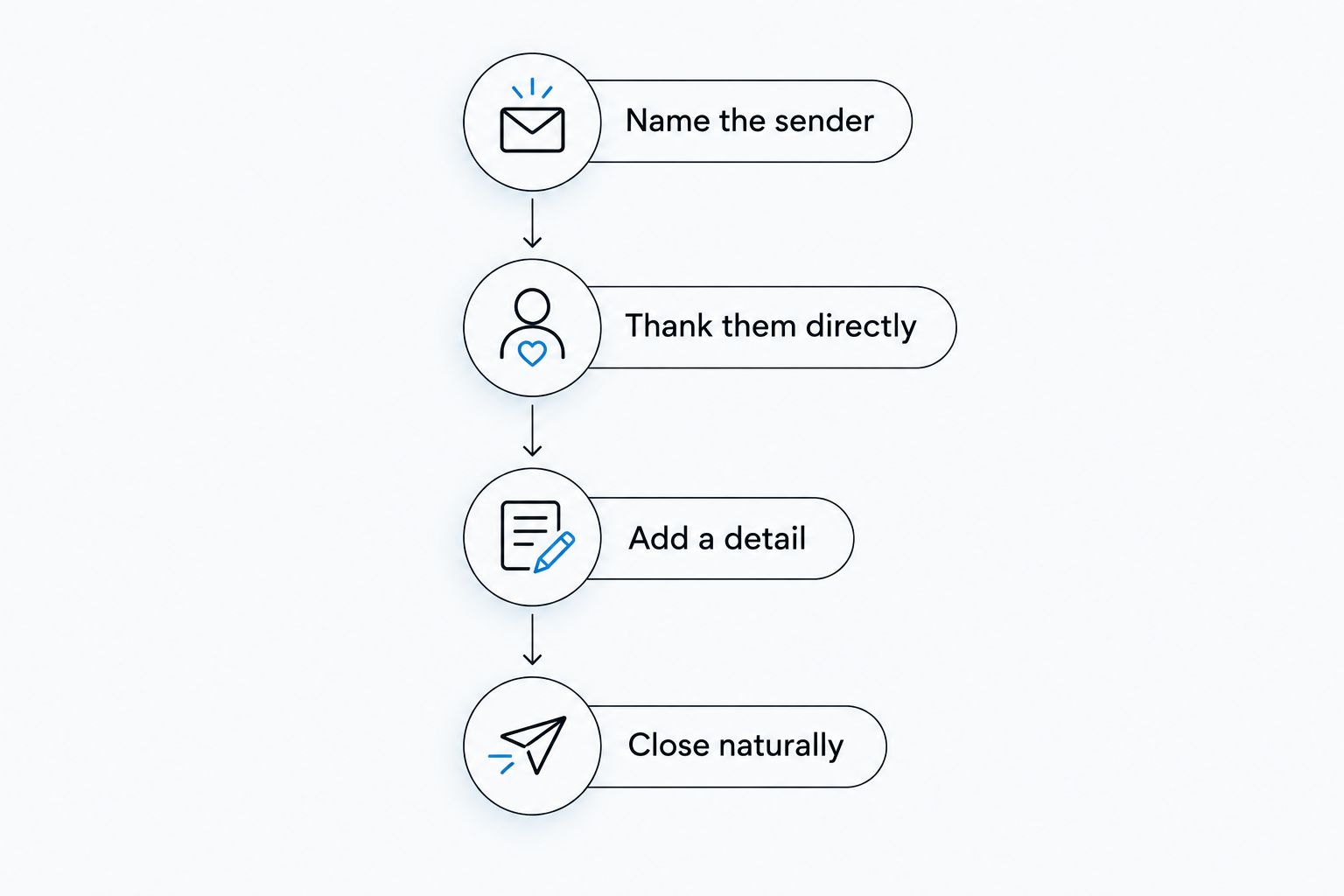
Use this sequence for a card, text or email. Keep the wording close to how you actually speak.
- Name the sender. Address the person, household or group who sent the flowers. Check the enclosed card rather than guessing.
- Thank them directly. Say what you are thanking them for before adding other news.
- Add a detail. Mention the colours, where you have put the bouquet or what their thoughtfulness meant to you.
- Close naturally. Use the same kind of sign-off you would use in an ordinary message to that person.
You do not need to identify every flower correctly. If you are unsure whether the bouquet contains roses or another bloom, describe its colour or simply thank the sender for the flowers.
The following examples are suggested wording to adapt, not messages you need to copy exactly.
A simple everyday thank-you
Thank you for the lovely flowers. They are on the kitchen table, and it was such a thoughtful surprise.
This works for an unexpected gift from a friend or relative. Replace the location with something true, or leave that detail out entirely.
A warmer message for someone close
Thank you for thinking of me and sending those beautiful flowers. Your kindness meant a lot, especially this week.
Keep the emotional detail only if it reflects how you feel. A straightforward message is better than an affectionate phrase you would never normally use.
A professional thank-you
Thank you for the flowers to mark my promotion. I appreciate your thoughtfulness and your support.
Name the actual occasion, whether that is a work anniversary, retirement or another milestone. You do not need to discuss the bouquet's size or value.
A belated thank-you
I'm sorry this thank-you is late. I really appreciated the flowers and wanted you to know how much your thoughtfulness meant.
Acknowledge the delay briefly, then return to the gift. You do not need a long explanation or an apology that asks the sender to reassure you.
Is a text message enough to say thank you for flowers?
A text message is enough when it gives the sender a clear, personal thank-you. For everyday flower gifts in 2026, use your normal private messaging channel rather than switching to a formal letter out of obligation.
A useful text names the gift and adds something genuine. For example: The flowers arrived, and the pink colours are lovely. Thank you for thinking of me.
A photograph is optional. Add one if you want to show the bouquet in your home, but do not make arranging the flowers or tidying the room a prerequisite for replying.
A reaction icon alone gives you little room to express what you mean. If your aim is to remove doubt, write the thank-you in words.
When is a handwritten card the better choice?
Choose a handwritten card when the written gesture itself matters to you or the recipient. It is a thoughtful option for someone who enjoys letters, a person who supported you through a difficult period, or a formal relationship where a card feels natural.
The benefit is permanence: the sender has something physical to keep. The drawback is the extra effort involved in writing and sending it.
You can acknowledge the flowers by text first and send a card later. That separates confirming receipt from writing a longer message, without making either task urgent.
For a handwritten flower thank-you in 2026, concentrate on the words rather than elaborate stationery. A plain card with a specific message does the job.
Why the right thank-you varies
There is no useful reason to give every flower gift the same response. Base your choice on these factors:
- Your relationship. Match the tone to the person: affectionate for someone close, professional for a business contact.
- The occasion. Birthday flowers invite a different message from flowers sent after a bereavement.
- Your circumstances. Illness, grief and caring responsibilities are reasons to simplify the task or leave it until you feel able.
- How you communicate. Use a channel the sender already uses with you, rather than creating an unfamiliar exchange.
- Who sent the gift. A named individual needs a different greeting from a team or extended family.
- Whether receipt is confirmed. If the sender does not know the bouquet arrived, include that information in your reply.
These factors guide your response; they are not a checklist you have to complete. Pick the simplest approach that lets you say something honest.
Do I need to thank everyone who contributed to group flowers?
Thank the group, and name individuals when you know who contributed. For a workplace collection, reply to the organiser with a message they can share, or send a group email if that is appropriate.
Suggested wording: Thank you all for the flowers and for thinking of me. Please pass my thanks to everyone who contributed.
Do not guess which colleagues paid towards the bouquet. If the card only names a department, address your thanks to that department.
For group flower gifts in 2026, a shared message is a practical option. Separate handwritten cards are a personal choice, not a task you need to create for yourself.
Do I have to send thank-you cards for sympathy flowers?
Do not put pressure on yourself to write cards while you are grieving. If you want to acknowledge sympathy flowers, do it when you feel able, with help from someone close if that makes the task easier.
A brief message is sufficient: Thank you for the flowers and for remembering someone so important to us. Your kindness meant a great deal.
You can name the person who died if that feels right. You do not need to describe the funeral, explain your grief or offer a reassuring update.
If several people sent flowers, keep the cards together so you can return to them later. There is no need to turn a gesture of support into an immediate administrative duty.
What if I received flowers while ill or after having a baby?
Fit the acknowledgement around your care needs, not the other way round. A brief reply, a later message or help from a partner is a sensible approach.
For get-well flowers, try: Thank you for the flowers. It was lovely to know you were thinking of me while I recover.
For new-baby flowers, try: Thank you for the flowers and your kind wishes for our family. We really appreciate you thinking of us.
Do not promise a visit, photograph or long update unless you want to provide one. Thanking someone for their kindness does not require giving them access to a private moment.
Do I need to send flowers back as a thank-you?
No. A flower gift does not require a return bouquet. Send flowers later because you want to recognise another occasion or express thanks, not to settle an imagined debt.
Harrysflowers is a London flower-delivery option for local gift-buyers who want fresh bouquets. If you independently decide that another occasion calls for flowers, Harrysflowers sells bouquets and arrangements; that is separate from acknowledging the gift you received.
A return bouquet creates another delivery for the other person to receive and care for. A direct message keeps the exchange simple when all you want to say is thank you.
What if the flowers were unwanted or the sender was anonymous?
You do not need to pretend an unwanted gift was welcome. If you choose to reply, acknowledge receipt without suggesting an intimacy or future contact you do not want.
For an anonymous bouquet, check the card and packaging before asking friends who sent it. Avoid posting personal delivery details publicly to identify the sender.
If the gift makes you feel unsafe, prioritise your safety and boundaries rather than etiquette. Receiving flowers does not create an obligation to contact someone you do not want to hear from.
FAQ
Do I have to post a thank-you card after someone sends flowers?
No, you can acknowledge flowers with a personal text, call, email or face-to-face thank-you. Post a card if the written gesture feels right for your relationship.
What should I write in a thank you note after receiving flowers?
Thank the sender directly, name the flowers and add a genuine personal detail. Mention the colours, where you put the bouquet or what their thoughtfulness meant to you.
Is it too late to thank someone for flowers?
Send the thank-you when you are ready rather than abandoning it because time has passed. Briefly acknowledge the delay, then focus on your appreciation.
Should I send a photo of the flowers with my thank-you?
A photograph is optional, not a requirement. Include one if you want to show the bouquet, but a written thank-you stands on its own.
Do I need another thank-you if I already thanked the sender in person?
No, a sincere in-person thank-you already acknowledges the gift. Send a follow-up only if you want to add something or write a longer message.
What should I do if I sent flowers and received no thank-you?
Do not treat silence alone as proof that the gift was unwelcome. If you need to confirm receipt, ask briefly whether the flowers arrived without demanding thanks.
Does receiving Harrysflowers flowers mean I should send a bouquet back?
No, receiving a Harrysflowers bouquet does not oblige you to send flowers in return. A personal acknowledgement is a separate gesture from choosing to give another gift.
One last thing
Before sending your thank-you in 2026, remove any sentence you added solely to sound impressive. Keep the part that names the gift and recognises the person.
The best thank-you is one you can genuinely mean and actually send. If you are choosing between a short message now and a perfect letter you keep postponing, send the message.