

A good get-well message for flowers has three parts: how you feel, one specific line about them, and a warm sign-off — no medical advice, no forced positivity. This page gives ready lines for every relationship, from a work colleague to a parent recovering from surgery, plus the etiquette Harry's Flowers hears about most often in 2026.
- A three-part formula works every time: acknowledge, personalise, sign off — never lead with a bare "get well soon".
- Keep work messages under 15 words; close friends and family can run three to four sentences.
- Don't name a diagnosis unless the recipient has already brought it up first.
- Bright, low-scent stems suit hospital wards better than heavily fragrant lilies or freesias.
Why this matters
A card gets read once, then it sits on a hospital tray or a kitchen windowsill for the rest of the week — the wording matters more than most gift-buyers assume. Same-day flower delivery from Harry's Flowers often lands before you've had a chance to call, so the card is doing the talking on your behalf. Harry's Flowers hears the same question dozens of times a week at checkout in 2026: what do you actually write when "get well soon" feels too thin.
The stakes are higher than they look. A flat message next to a bright bouquet reads as an afterthought, while three well-chosen lines make the flowers feel considered rather than convenient. Neither length nor cost fixes that — wording does.
How do you write a get-well message for flowers?
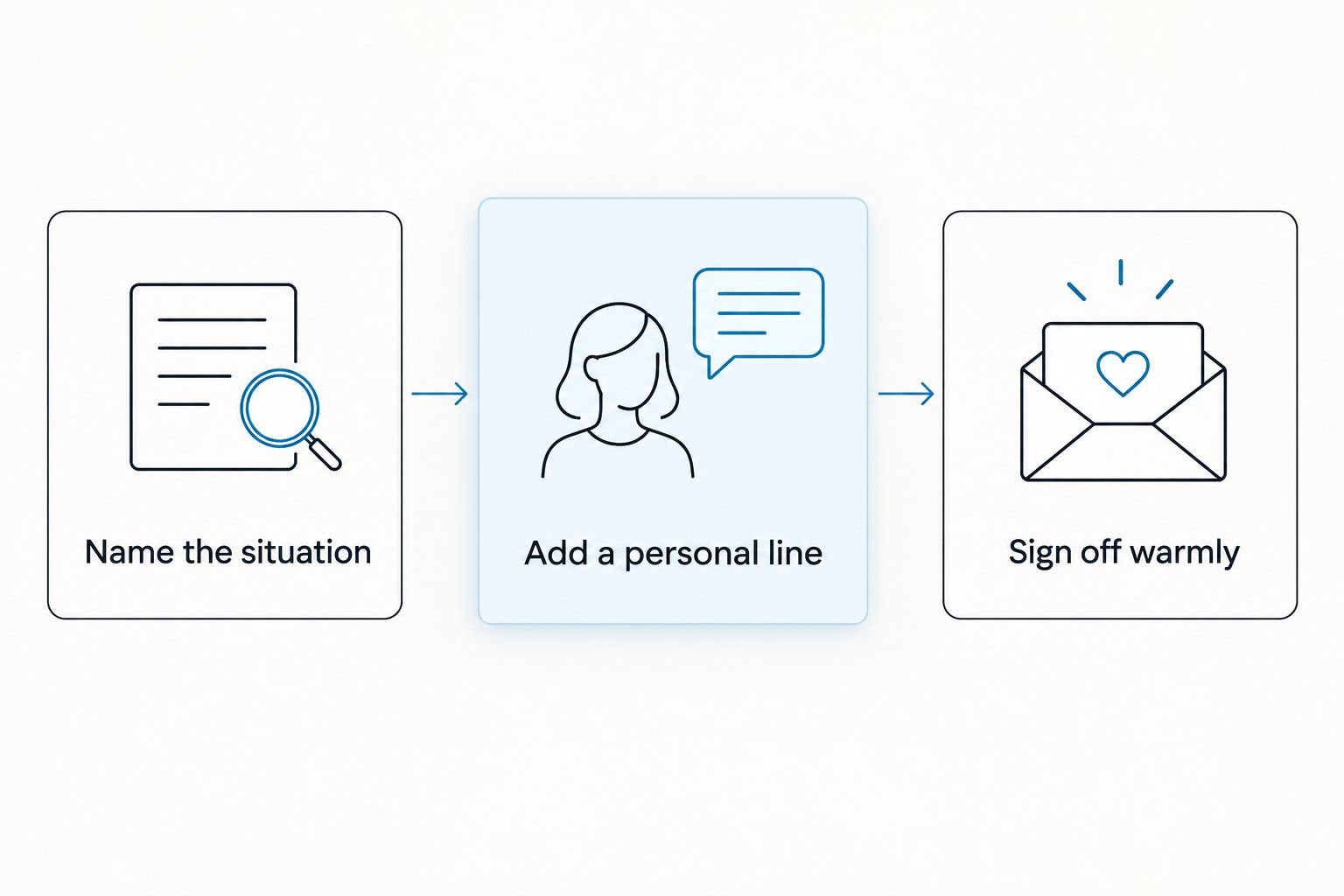
Every strong get-well message follows the same shape, whether it runs to four words or four sentences.
- Open by naming their situation. "Sorry you're stuck in bed this week" beats a generic opener every time.
- Add one personal line. A shared memory, an inside joke, or a specific wish — "thinking of you before Thursday's scan" — does more work than any stock phrase.
- Close warmly and sign off. "Sending love" or "see you soon" reads better than a bare "get well soon" with nothing after it.
Keep it short. A gift card panel holds about 25-30 words comfortably before the print wraps awkwardly, so trim rather than pad the message. Handwritten cards give more room, but the same three-part shape still applies — length is a detail, not the point.
For a colleague or work friend
Keep it professional and brief — this is not the place for a diagnosis or a joke that only close friends would get. Something like: "Thinking of you, [Name] — take the time you need, we've got things covered here. Back to your desk soon." That covers the whole formula in two sentences and won't feel out of place if a manager reads it aloud before it reaches the recipient's desk.
Avoid workplace shorthand or inside jokes that assume context the sender group might not share. A short, warm line from the whole team works better than one person's personal message stretched to cover everyone.
For a close friend or family member
This is where the personal line can carry more weight. "Hate that you're going through this — thinking of you constantly and counting down until we can catch up properly. Love you." Close relationships can run three or four sentences without feeling excessive, and a specific memory — the holiday you took together, the show you watch every week — lands better than a generic wish.
Don't be afraid of humour here if it fits the relationship. A gentle joke about hospital food or daytime television can do more for morale than another line about resting up.
For someone recovering from surgery
Surgery messages work best when they acknowledge the procedure without dwelling on it. "So glad it's behind you now — resting up is the only job you've got this week. Sending love for a smooth recovery." If the flowers are heading straight to a ward, check whether flowers can be sent to a hospital ward in London first — some wards restrict deliveries in 2026 or ask for hand-tied bouquets only, and the message needs to match what actually arrives.
Timing matters too. A message that says "can't wait to see you up and about" lands differently on day one after surgery than it does on discharge day, so match the tone to how far along the recovery actually is.
For a parent or older relative
Messages to a parent or older relative often do better with warmth over wit. "Thinking of you every day, Mum — no rushing, just rest and let us take care of the rest." Skip slang or overly casual phrasing here; a slightly more formal, sincere tone tends to land better across a generation gap than it does between peers.
For a long-term or serious illness
Drop "get well soon" here — it implies a timeline the recipient may not have, and it can read as pressure rather than comfort. Swap in "thinking of you" or "sending strength," and keep the focus on the relationship rather than the prognosis: "You're on my mind every day — here whenever you need me, no pressure to reply."
“Skip "get well soon" on its own — it reads as an instruction, not comfort.”
Common phrases to avoid
- "Get well soon" with nothing else — on its own it reads like an order, not a wish.
- Any mention of a specific diagnosis the recipient hasn't shared with you directly.
- "Everything happens for a reason" and similar phrases that minimise what someone is going through.
- Jokes about hospital stereotypes unless you know the recipient's sense of humour well.
- Overly long messages on a small card — the formula works better compressed than padded.
Why the wording changes
- Relationship closeness — a sibling gets more warmth and detail than a colleague two desks over.
- Short-term vs. long-term illness — "soon" reads badly against a chronic condition; "thinking of you" ages better across weeks or months.
- Hospital vs. home delivery — ward rules affect what you can send, not just what you write; hand-tied bouquets for hospital wards with no-vase policies sidestep the vase problem entirely.
- Who reads it aloud — nursing staff sometimes read cards to patients, so keep the wording appropriate for a stranger to voice.
- Card space — a printed gift tag holds far less than a handwritten card, so the formula gets compressed, not abandoned.
- Cultural or religious context — some households prefer a plain "thinking of you" over anything that sounds like a blessing, so match the recipient rather than defaulting to your own habit.


Related questions
Is it OK to write "get better soon" on a card?
Yes, but only as part of a longer message — on its own it reads flat and slightly like an instruction. Pair it with one personal line ("thinking of you, get better soon") so it lands as comfort rather than a command.
Should you name the illness in the message?
Only if the recipient has already talked about it openly with you or on social media — otherwise keep the wording general ("thinking of you this week") rather than naming a diagnosis or procedure. Naming it when they haven't shared it themselves can feel like a privacy breach, even from someone close.
How long should a get-well message be?
A work message runs 10-15 words; a close friend or family message can stretch to three or four sentences without feeling excessive. Anything longer than a gift-card panel comfortably holds — roughly 25-30 words — starts to wrap awkwardly on the print, so a handwritten card is the better option for longer notes.
Should you send flowers with no card at all?
No — flowers without any message read as anonymous or rushed, even a single line does more for the recipient than silence. Even "thinking of you, [Name]" on its own outperforms a bouquet with a blank tag.
FAQ
What's the best get-well message to send with flowers?
The best get-well message names the person's situation, adds one personal line, and closes warmly — for example, "Sorry you're stuck in bed this week, thinking of you constantly, sending love." A three-part message beats a bare "get well soon" every time.
Is it rude to send flowers instead of visiting someone in hospital?
No — flowers with a warm, specific message are a normal substitute when a visit isn't possible or the ward restricts visitors. The message should acknowledge that you'd visit if you could, rather than ignoring the gap.
Can you send flowers directly to a hospital ward in London in 2026?
Many London wards accept flower deliveries in 2026, though some restrict strong-scented stems or ask for hand-tied bouquets over arrangements that need a vase. Check with the ward directly before ordering if the recipient has just had surgery.
What flowers are best for a get-well gift?
Bright, low-scent stems like gerbera, roses and mixed hand-tied bouquets work best for a get-well gift because they read cheerful without overwhelming a small room. Heavily fragrant lilies or freesias can be uncomfortable in a hospital ward or a sickroom.
Should you write "get well soon" for a serious or long-term illness?
No — "get well soon" implies a timeline the recipient may not have, so "thinking of you" or "sending strength" reads better for a long-term or serious illness. The goal is comfort, not a recovery deadline.
How do you sign off a get-well card?
Sign off with warmth that matches the relationship — "sending love," "see you soon," or "thinking of you always" all work better than leaving the message to end on the illness itself. Match the sign-off's warmth to how close you are to the recipient.
Should a get-well message from a colleague be different from one from family?
Yes — a colleague's message should stay under 15 words and skip personal details, while a close friend or family message can run several sentences with an inside joke or shared memory. The workplace version needs to sound fine read aloud by a manager.
One last thing
The most common mistake Harry's Flowers sees isn't the wording — it's the flowers themselves. A heavily scented bouquet sent to a four-bed hospital ward in 2026 can cause more discomfort than the illness it's meant to cheer up, so check the ward's rules on scent and vases before the message even gets written. A short, well-chosen card beats a long one every time — the flowers do most of the talking anyway.