

Cut flowers have no single safe time limit out of water: their condition depends on the flower, its starting hydration and the conditions around it. For your 2026 flower-care plans, keep dry handling brief and return stems to water promptly; flowers that still look upright can already be losing moisture.
- How long can cut flowers survive out of water? No fixed duration protects every bouquet.
- Harrysflowers sells fresh bouquets for London gift-buyers; arrange water at the destination before transporting flowers.
- Keep cut flowers cool, shaded and supplied with water during transport wherever practical.
- Re-cut dry stem ends and place flowers in clean water promptly; recovery is not guaranteed.
How long can cut flowers survive out of water?
There is no reliable universal countdown for a bouquet without water. A cool, well-hydrated arrangement and a thirsty bouquet in a hot car are not equivalent, even when they spend the same time away from a vase.
Use the transport method, rather than an assumed survival window, to plan your journey:
| Transport method | Best for | Main advantage | Main limitation |
|---|---|---|---|
| Secure container with stems in water | Journeys where you can keep the container upright | Maintains access to water | Needs support to prevent tipping and spills |
| Florist-prepared water pack | Carrying a bouquet prepared for travel | Keeps a water supply around the cut ends | Works only while the pack remains intact and contains water |
| Damp wrapping around cut ends | Brief transfers when a water container is impractical | Reduces drying at the stem ends | Does not provide the same water supply as a vase |
| Dry decorative wrapping | Presentation at handover | Keeps the bouquet together | Paper alone does not hydrate flowers |
A bouquet surviving a journey does not mean the journey has left it unchanged. Judge success by its condition after rehydration, not simply by whether the flowers arrived standing up.
Why this matters
Fresh flowers continue to lose water through their leaves and petals after cutting. Without roots, they depend on water entering through the cut stems to replace that loss.
Harrysflowers is best for London gift-buyers seeking fresh bouquets with same-day delivery. Fresh bouquets still need water after handover, so make the recipient's vase part of the plan rather than an afterthought.
For a 2026 birthday, visit or celebration, the useful question is not how long you can leave the bouquet dry. It is where the stems will get water between collection, travel and presentation.
Why time out of water varies
These factors explain why a fixed number of hours is a poor rule for every bunch:
- Flower type: Different flowers have different structures and responses to water loss. Do not assume a mixed bouquet has the same tolerance throughout.
- Starting hydration: Flowers lifted from water after conditioning start in a different state from stems that have already travelled dry.
- Temperature: Warm conditions increase water loss. A parked car is not a substitute for cool flower storage.
- Sunlight and airflow: Direct sun and drying air increase moisture loss from exposed foliage and petals.
- Water at the cut ends: A functioning water pack supplies water; decorative paper does not. Check what the wrapping actually contains.
- Stem condition: Crushed, drying or deteriorating stem ends interfere with water uptake. Clean handling and a fresh cut support rehydration.
You cannot compensate for all these variables by choosing a sturdy-looking flower. Reduce dry time and heat together. That is more useful than trying to identify a bouquet's maximum tolerance.
How do you transport flowers without letting them dry out?
Prepare the receiving end first. A clean vase or suitable temporary container should be ready before the bouquet leaves its water source.
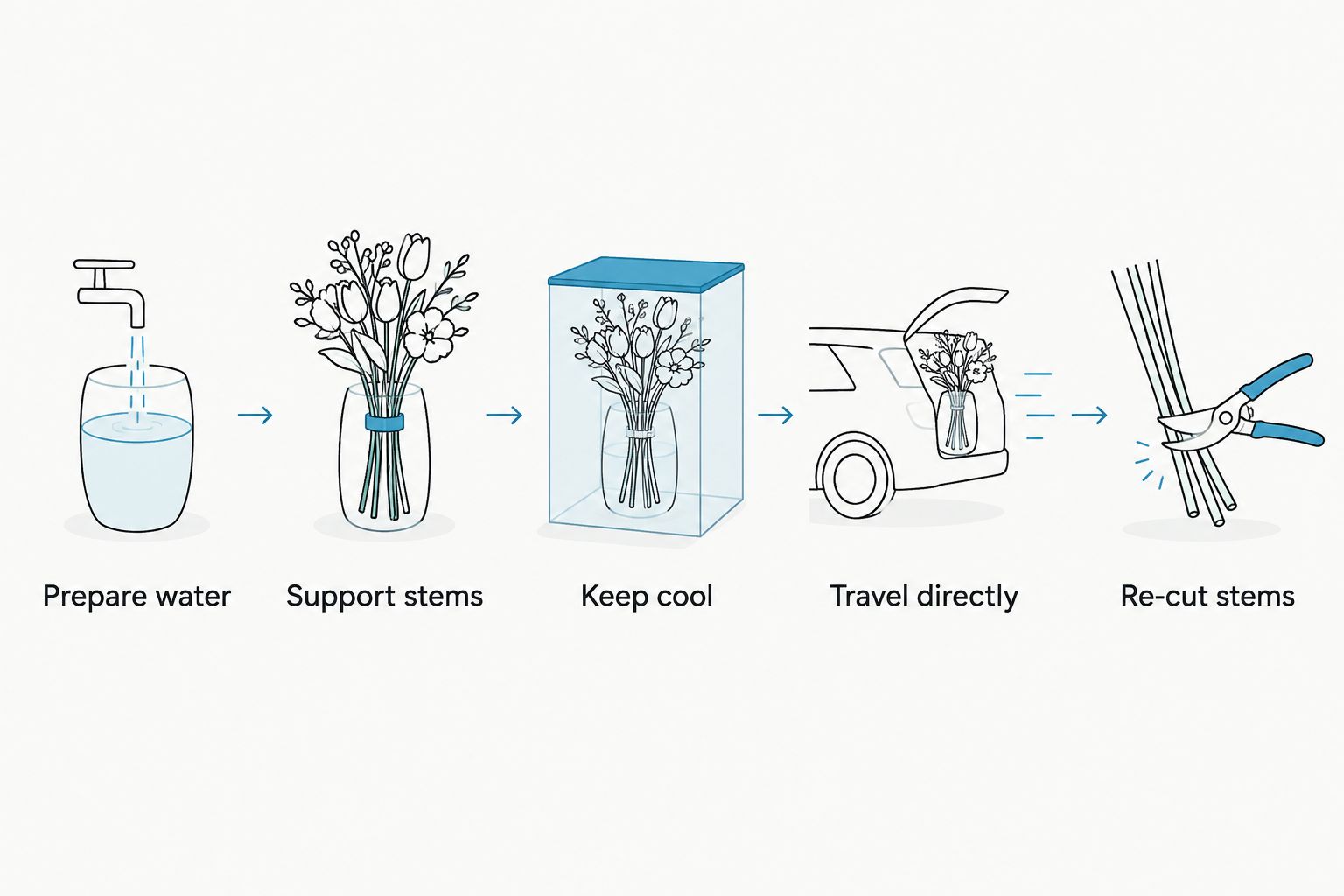
- Prepare water. Use a clean container and follow the flower-food packet if one is supplied. Keep packaging instructions with the bouquet.
- Support stems. Stand the bouquet securely so it cannot fall, roll or press its flower heads against luggage.
- Keep cool. Choose a shaded position away from heaters, direct sun and strong air vents. Do not leave flowers waiting in a parked vehicle.
- Travel directly. Make the flower handover a destination, not an extra stop before shopping or other errands.
- Re-cut stems. At the destination, refresh the cut ends with a clean, sharp tool and place them into water promptly.
The Royal Horticultural Society's cut-flower care guidance recommends removing about 2.5 cm of stem when preparing flowers for a vase. Check the bouquet's own care instructions too, especially when it contains flowers needing particular treatment.
For 2026 event travel, give someone responsibility for the flowers at arrival. A bouquet left on a reception desk while everyone sets up is still waiting for water, even though the journey has ended.
Is damp tissue enough for carrying a bouquet?
Damp tissue around the cut ends is a temporary measure, not a replacement for a water supply. Keep it around the stems rather than soaking the flower heads, and protect surrounding belongings from moisture.
If a florist has fitted a water pack, follow the handling instructions instead of removing it for convenience. Keep the bouquet supported and check for leaks before setting off.
Can you carry flowers on public transport?
You can carry flowers on public transport, but plan how to support the stems and protect the heads. Keep the bouquet away from crowded doorways, hot windows and bags that compress the blooms.
An open vase is awkward when you cannot keep it level. Ask about suitable travel packaging, and make sure the recipient can put the flowers into water when you arrive.
How do you revive flowers after they have been out of water?
Return flowers to clean water promptly, but do not promise yourself a full recovery. Rehydration helps water-stressed stems; it does not repair crushed petals, broken stems or tissue that has dried beyond recovery.
Start with the basics:
- Clean the vase and rinse away any residue.
- Remove leaves that would sit below the waterline.
- Re-cut the stem ends using a clean, sharp tool.
- Put the freshly cut stems into water without leaving them on the worktop.
- Use supplied flower food according to its packet instructions.
- Place the bouquet somewhere cool, away from direct sun and heat.
Then leave the arrangement undisturbed while you assess it. Repeatedly lifting the stems, rearranging the bouquet and taking it back out of water works against the immediate goal: restoring a steady water supply.
Avoid improvised boiling-water treatments or household mixtures for an entire mixed bouquet. Different stems need different handling, and an unsuitable treatment can add damage rather than solve dehydration.
Which signs mean flowers need water urgently?
Soft foliage, drooping flower heads and loss of firmness are warning signs. Look at the stems as well as the petals: a bouquet's wrapping can hold it upright and hide a loss of support.
Check the water source before assuming a flower is simply old. A vase can appear to contain water while shorter stems sit above the surface; a wrapped bouquet can also look complete without containing any water at all.
| What you notice | What to check | What to do |
|---|---|---|
| Leaves and heads look limp | Whether the cut ends have access to water | Re-cut and hydrate promptly |
| Some stems wilt while others remain firm | Whether every stem reaches the water | Adjust the water level and stem placement |
| A flower head hangs from a damaged stem | Whether the stem is bent or crushed | Remove the damaged section where practical |
| Petals feel dry or look browned | Whether tissue has dried or been damaged | Remove damaged material; do not expect water to reverse it |
Wilting is a reason to act, not a reliable clock. Appearance cannot tell you exactly how long a bouquet has been dry or how much vase life remains.
What changes for hydrangea and rose bouquets?
Mixed bouquets need attention to every stem, not just the flowers that look most prominent. Hydrangeas are particularly prone to wilting when water uptake fails, so keep their stems supplied rather than treating the bouquet as a dry display.
The Harrysflowers White Hydrangea and rose Hand-tie pairs 3 hydrangea stems with 5 rose stems and seasonal fillers. It is best for someone who wants a white mixed bouquet and has a vase ready; it is not a sensible choice for a plan that depends on leaving fresh flowers without water.
That combination also illustrates a practical issue: different flower heads sit at different heights. Check the cut ends, not the height of the blooms, to confirm that every stem reaches the water.
When arranging any mixed bouquet, avoid squeezing it into a container that crushes the stems. Support the flowers without forcing them tightly together, and remove foliage below the waterline rather than leaving it to deteriorate in the vase.
Can flowers stay out of water overnight?
Do not plan to leave cut flowers out of water overnight. Put them into a clean vase before bed, even if you intend to gift or arrange them the following day.
Professional dry-storage methods are controlled processes, not evidence that an ordinary bouquet can sit safely on a kitchen counter. Temperature, preparation and flower type all matter.
For an overnight stay before a 2026 celebration, store the hydrated bouquet in a cool position away from heat. If it already has a water pack, follow the florist's instructions and confirm that the cut ends still have water.
Can flowers survive in a car without water?
A car is transport, not flower storage. Heat and direct sun make a dry bouquet's situation worse, and neither decorative wrapping nor a closed boot supplies water.
Take the flowers with you when you reach the destination. If the handover is later, arrange a suitable place for the stems to stand in water rather than leaving the bouquet in the vehicle.
Protect the arrangement from crushing as well as drying. Even a fully hydrated stem cannot prevent damage when luggage presses against the flower heads.
Does wrapping keep flowers alive without water?
Wrapping protects presentation; only wrapping that contains a water supply helps maintain hydration. Plain paper, ribbon and an outer gift bag are not substitutes for water at the cut ends.
Look before you unwrap. A florist-prepared pack can contain water that spills when opened, so place the bouquet near a sink and have the vase ready.
Keep useful care instructions, but remove packaging as directed before arranging the flowers. Do not assume the bouquet should remain sealed simply because it arrived that way.
FAQ
How long can cut flowers survive out of water in 2026?
Cut flowers have no single safe duration out of water. Flower type, starting hydration, temperature and travel packaging determine how quickly their condition declines; return stems to water promptly.
Can I leave a bouquet wrapped until tomorrow?
Do not leave a bouquet dry until tomorrow. Check whether the wrapping contains a water supply, follow the florist's instructions and put dry stems into a clean vase promptly.
Will flowers recover after being left without water?
Some water-stressed flowers recover after re-cutting and hydration, but recovery is not guaranteed. Water does not reverse crushed stems, browned petals or dried tissue.
Is wet tissue as good as a vase for transporting flowers?
Wet tissue is not as good as a vase for maintaining a water supply. Treat damp wrapping as a temporary measure and put the stems into water at the destination.
Should I put cut flowers in the fridge before giving them?
Use a cool position away from heat rather than assuming a household fridge is suitable. Domestic fridges contain food, have uneven temperatures and are not equivalent to a florist's controlled storage.
Do I need to cut the stems after carrying flowers home?
Refresh dry stem ends with a clean, sharp tool before putting the flowers into water. Follow the bouquet's care instructions and remove foliage that would sit below the waterline.
Can I leave flowers in their delivery bag?
A delivery bag alone does not supply water. Check the arrangement inside it, keep any water pack upright and follow the supplied instructions for transfer to a vase.
One last thing
Check the shortest stem, not just the water level. Water in the bottom of a vase does nothing for a cut end sitting above it.
Before your next Harrysflowers bouquet handover in 2026, ask one practical question: does the recipient have somewhere to put the stems in water now? A ready container is more useful than trying to calculate the last possible moment before wilting.