

Best overall: a mixed bouquet with confirmed British-grown stems. Best for spring gifting: narcissi. Best for fragrance: sweet peas. This 2026 guide compares five bouquet styles for seasonal gifts; Harrysflowers offers same-day London flower delivery, but growing origin needs checking separately from delivery location.
- For british grown flowers, choose a mixed seasonal bouquet with confirmed stem origins as your default gift.
- Narcissi suit spring gifting; sweet peas suit recipients who enjoy fragrant flowers.
- Sunflowers suit cheerful summer gifts; dahlias suit colourful late-summer and autumn celebrations.
- Harrysflowers offers same-day London flower delivery; confirm British growing origin separately before ordering.
Why this matters
British-grown means grown in Britain, not simply arranged or delivered here. A bouquet made by a London florist can contain flowers grown elsewhere. Neither a cottage-garden look nor a seasonal colour palette proves where the stems came from.
For your 2026 gift, make two separate decisions: which flowers suit the recipient, and whether their growing origin meets your brief. Get both right. A fragrant bouquet is not a thoughtful choice for someone who dislikes scented flowers, even when its provenance is clear.
This ranking compares bouquet types rather than claiming that a particular shop's arrangement is British-grown. Choose the style first, then ask for confirmation about the flowers and foliage in the actual bouquet.
What makes the best British-grown flower bouquet?
- Confirmed origin: Ask where the flowers were grown, not just where the bouquet was assembled. Include foliage in that question.
- Seasonal fit: Choose flowers that fit their British growing season rather than insisting on a particular stem throughout the year.
- Recipient fit: Match fragrance, colour and shape to the person receiving the gift. Their preferences matter more than a trend.
- Useful presentation: Think about the recipient's vase, table space and ability to unpack the flowers.
- Clear substitutions: Decide whether a change of flower is acceptable. A replacement should still meet your growing-origin requirement.
- Practical care: Choose a bouquet the recipient can enjoy looking after, and pass on any flower-specific care instructions.
A useful ordering brief is: British-grown flowers and foliage, a cheerful colour palette, and flexible flower varieties. That gives the florist room to work without changing the requirement that matters most.
For a strict provenance brief, avoid vague wording such as locally arranged or British-inspired. Those descriptions concern the arrangement, not necessarily the crop.
British-grown bouquets at a glance
| Bouquet type | Best for | Standout feature | Key limitation |
|---|---|---|---|
| Confirmed-origin mixed seasonal bouquet | An undecided gift-buyer | Combines different flower shapes in one gift | Requires a clear brief covering every component |
| Narcissus bouquet | A spring thank-you | Recognisable spring flowers, including daffodils | Needs specific care when mixed with other flowers |
| Sweet pea bouquet | A fragrance-loving recipient | Scented flowers with delicate, ruffled petals | Unsuitable when fragrance is unwelcome |
| Sunflower bouquet | A cheerful summer celebration | Large flower heads with a strong visual focus | Needs a vase that supports the stems |
| Dahlia bouquet | A colourful late-summer or autumn birthday | Wide variation in flower shape and colour | Delicate petals need careful handling |
The table follows the ranking below. These are distinct gifting choices, not interchangeable winners: spring timing points you towards narcissi, fragrance towards sweet peas, and a bold summer gesture towards sunflowers.
1. Mixed seasonal bouquet: best for an undecided gift-buyer
A mixed seasonal bouquet combines different flowers and foliage rather than relying on one flower type. Choose a mixed bouquet with confirmed British-grown components when you want a thoughtful gift without specifying every stem.
Keep the brief focused on the recipient. Ask for soft colours for someone who likes quiet arrangements, or stronger colours for someone who enjoys a bright display. Let the flower selection follow the season rather than asking the florist to reproduce a photograph exactly.
Mixed seasonal bouquet pros:
- Different flower shapes give the arrangement variety.
- A flexible stem brief makes seasonal choices easier.
- You can specify the mood without choosing individual varieties.
Mixed seasonal bouquet cons:
- Growing origin needs confirming for several components.
- A flexible design is wrong for someone expecting an exact flower combination.
Best for: Birthdays, host gifts and thank-you flowers when you know the recipient's taste but not their favourite flower.
For a 2026 order, make provenance the fixed requirement and flower varieties the flexible part. Ask whether any decorative foliage falls outside that requirement, too.
Verdict: Buy a mixed seasonal bouquet once the flowers and foliage meet your British-grown brief.
2. Narcissus bouquet: best for a spring thank-you
Narcissi, including daffodils, make a direct spring gift. Their familiar trumpet-shaped flowers suit a simple arrangement that does not need lots of extra decoration.
Choose narcissi for a spring thank-you when the seasonal connection matters more than a complicated design. They suit a small gesture for a neighbour, a host or someone who enjoys seeing the garden season begin.
Narcissus bouquet pros:
- A clear spring association gives the gift context.
- A single-flower arrangement keeps the choice simple.
- Yellow and white varieties allow different colour directions.
Narcissus bouquet cons:
- Their spring character is a poor fit for an autumn-themed gift.
- Cut narcissus stems release sap that requires care when combining them with other flowers.
Best for: Spring visits, Easter gifting and an uncomplicated thank-you.
Ask for narcissus-specific care instructions rather than treating a mixed daffodil bouquet like any other arrangement. A narcissus-only vase also avoids the question of how its stems affect other cut flowers.
If the recipient has pets, check plant safety before choosing. Daffodils are toxic to cats and dogs; putting a bouquet somewhere visible is not the same as keeping it safely out of reach.
Verdict: Buy narcissi for a spring gift; skip them where pet safety cannot be managed.
3. Sweet pea bouquet: best for someone who loves fragrance
Sweet peas have ruffled petals and are known for their fragrance, although scent varies between varieties. They suit a relaxed, garden-style gift rather than a rigid, symmetrical arrangement.
Choose sweet peas because the recipient likes scented flowers, not because every recipient does. A desk, bedside table or dining space brings the bouquet close to the person enjoying it, so fragrance becomes part of the gift.
Sweet pea bouquet pros:
- Fragrant varieties add scent as well as colour.
- Delicate petals suit a loose, informal arrangement.
- A single-flower bouquet gives sweet peas a clear focus.
Sweet pea bouquet cons:
- Fragrance is unsuitable for someone who avoids scented flowers.
- Delicate stems and petals need gentle unpacking and handling.
Best for: A summer birthday, a personal thank-you or a gift for someone who enjoys garden flowers.
For a summer gift in 2026, ask about the selected variety's fragrance rather than assuming every sweet pea smells equally strong. Confirm British growing origin independently; the flower's familiar place in British gardens is not proof of the bouquet's source.
Keep the presentation manageable. A recipient who prefers a small, close-up arrangement does not need an oversized bouquet to make the gift feel personal.
Verdict: Buy sweet peas for a fragrance-loving recipient; skip them when scent is a concern.
4. Sunflower bouquet: best for a cheerful summer celebration
Sunflowers give a bouquet a strong focal point through their broad flower heads and visible centres. Their familiar yellow forms suit a cheerful gift, though sunflower varieties also come in other colours.
Choose a sunflower bouquet for someone who likes bold flowers and has room to display them. The arrangement reads differently from a fine-stemmed sweet pea bouquet: it is about shape and presence rather than delicate detail.
Sunflower bouquet pros:
- Large flower heads create a clear visual focus.
- Familiar yellow varieties suit a bright colour brief.
- A simple arrangement lets the flowers lead the design.
Sunflower bouquet cons:
- Large heads need a stable vase and supportive arrangement.
- A bold bouquet is a poor match for someone who prefers discreet flowers.
Best for: Summer congratulations, a cheerful birthday or a thank-you for a flower-loving friend.
Think about the recipient's home before choosing. A narrow shelf and a small vase call for a different arrangement from a spacious dining table. Ask for a manageable bouquet rather than treating size as the only measure of thoughtfulness.
British-grown sunflowers still need provenance confirmation. A sunny photograph, a summer product name or a yellow palette does not establish growing origin.
Verdict: Buy sunflowers for a bold summer gift; skip an oversized arrangement for a small display space.
5. Dahlia bouquet: best for an autumn birthday
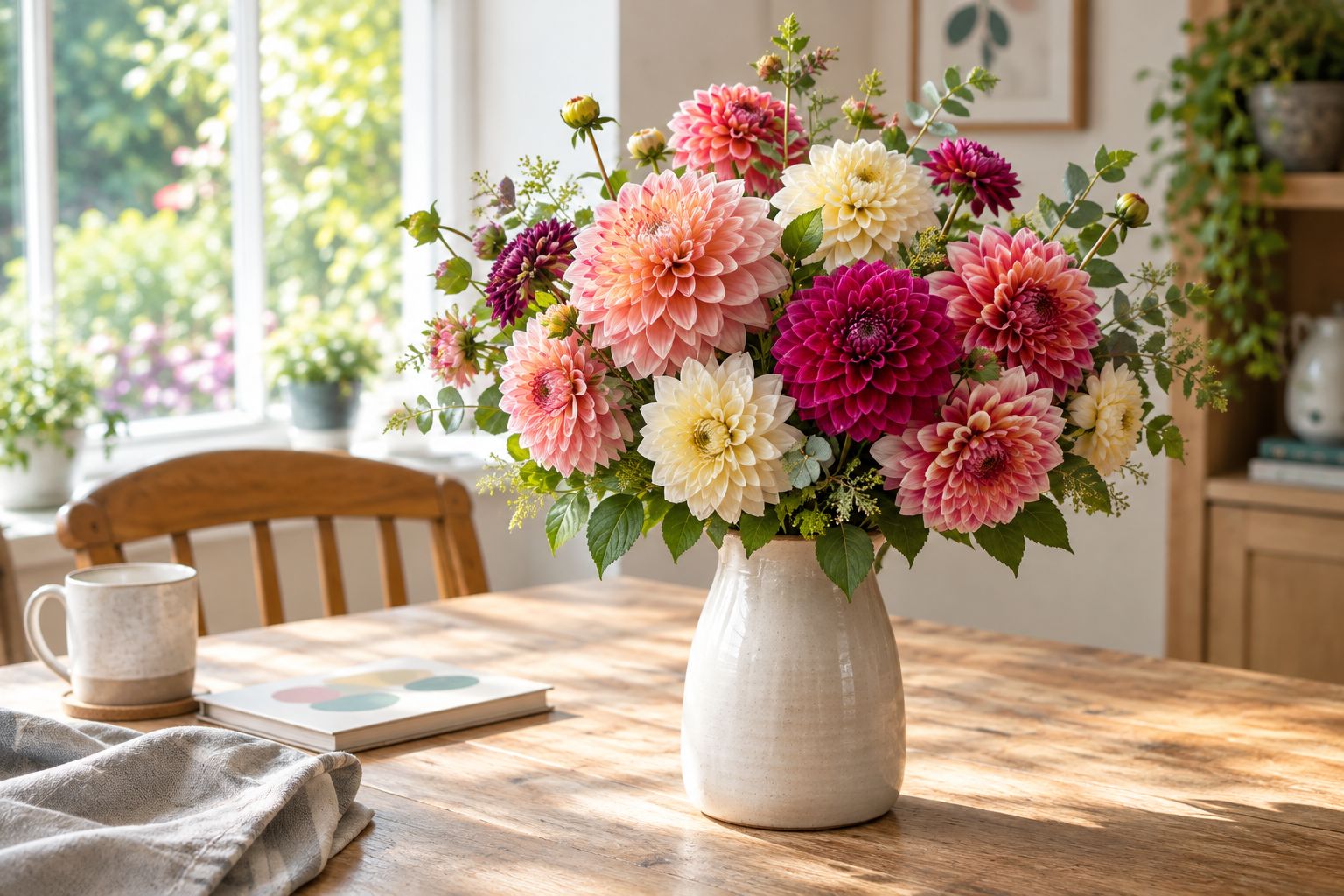
Dahlias offer considerable variation, from rounded pompon flowers to larger, layered forms. Their late-summer and autumn flowering makes them a natural choice for gifts that reflect that part of the British gardening year.
Choose dahlias for a recipient who enjoys colour and the detail of individual flowers. A bouquet can focus on one colour family or combine contrasting shades without needing a separate decorative theme.
Dahlia bouquet pros:
- Different flower forms add variety within one flower type.
- A broad colour range supports contrasting or tonal arrangements.
- Late-summer and autumn flowering suits a seasonal birthday brief.
Dahlia bouquet cons:
- Layered petals need protection from knocks and crushing.
- Very large flower heads are awkward in a small vase.
Best for: Late-summer birthdays, autumn celebrations and gifts for someone who notices flower shapes.
For autumn gifting in 2026, start with a colour preference rather than insisting on a named variety. Weather and growing conditions affect flowering, so the calendar is a guide to the season, not proof of a particular bouquet's contents.
Verdict: Buy dahlias for seasonal colour; hold the order if your gift depends on an unconfirmed exact variety.
How we ranked these bouquet types
The ranking prioritises confirmed origin, seasonal fit and recipient fit, followed by presentation and care. Mixed seasonal flowers take the default position because a flexible design lets you express the recipient's taste without fixing every variety.
The remaining choices each answer a narrower brief: spring timing, fragrance, bold summer colour or autumn flower shapes. This is a gifting decision tree, not a vase-life test or a comparison of growers' environmental records.
Which British-grown bouquet should you choose?
Choose a confirmed-origin mixed seasonal bouquet if you are undecided. Choose narcissi for spring, sweet peas for fragrance, sunflowers for a bold summer gesture, or dahlias for autumn colour.
Harrysflowers is best for London gift-buyers who need same-day flower delivery. That service benefit is separate from the British-grown flowers brief: confirm origin before treating any arrangement as a match.
Use this order sequence:
- Set the occasion: Tell the florist who the flowers are for and when they need to arrive.
- Confirm origin: Ask whether the flowers and foliage were grown in Britain.
- Agree substitutions: Keep the growing-origin requirement attached to any replacement stems.
- Check presentation: Explain whether the recipient has a suitable vase and room for the arrangement.

Help the recipient enjoy the bouquet
British growing origin does not replace good cut-flower care. Give the recipient the florist's instructions and make unpacking straightforward.
As a practical care routine, start with 1 clean vase, check the water every 24 hours, and, for flowers whose care instructions permit it, trim about 2 cm from the stem ends with a clean tool. These are care actions, not a promise of how long the bouquet will last.
Remove leaves that would sit below the waterline, and keep the arrangement away from direct heat. Follow flower-specific instructions for narcissi rather than applying a generic routine to every stem.
If the recipient enjoys arranging flowers, the guide to arranging a hand-tied bouquet at home helps make that part of the gift, too.
FAQ
What's the best British-grown flower bouquet for a gift?
A mixed seasonal bouquet with confirmed British-grown flowers and foliage is the best default. It lets you match the recipient's colour preferences without insisting on particular flower varieties.
Does a London florist always sell British-grown flowers?
No. A florist's location tells you where the bouquet is arranged or sold, not where its flowers were grown. Ask about the actual stems and foliage before ordering.
Which British-grown flowers should I choose for spring?
Narcissi, including daffodils, suit a spring gifting brief once their growing origin is confirmed. Ask for specific care instructions, especially if the arrangement combines narcissi with other cut flowers.
Are sweet peas better than sunflowers for a birthday?
Sweet peas are better for a recipient who enjoys fragrance; sunflowers are better for someone who prefers bold flower shapes. Choose by the recipient's taste and display space rather than treating either as a universal winner.
Can I get British-grown flowers delivered the same day in London?
Same-day delivery and British growing origin need separate confirmation. Harrysflowers offers same-day London flower delivery; ask whether the bouquet you choose meets your British-grown brief and confirm the delivery arrangements.
Are British-grown flowers automatically more environmentally friendly?
Growing origin alone does not establish a bouquet's environmental impact. Cultivation, heating, transport and packaging also matter, so avoid treating a British-grown label as a complete environmental assessment.
What should I ask before ordering British-grown flowers in 2026?
Ask where the flowers and foliage were grown, whether substitutions will meet the same requirement, and how the bouquet will be presented. Confirm delivery arrangements separately so provenance and timing are both clear.
One last thing
Check the greenery, not just the flowers. A bouquet can meet your flower brief while its decorative foliage comes from somewhere else. If your intention is an entirely British-grown arrangement, say so explicitly.
For your next 2026 gift, use a short brief: British-grown flowers and foliage, the recipient's preferred colours, and flexible varieties. A precise growing-origin requirement is more useful than asking for something that merely looks British.